


Executive Reference Checking: How Search Firms Handle Due Diligence
Written references now say almost nothing. What replaces them is a structured process of conversations, record checks and judgement, and whether a board is willing to act on what comes back. Estimated Reading Time: 12 MinutesAsk a large UK corporate for a written reference on a departing executive, and you will most likely receive three lines: job title, start date, end date. Across the mandates we run, factual-only reference policies have become the norm rather than the exception over the past decade, driven by the fear of negligent misstatement claims, and they have quietly stripped the written reference of nearly all its value.
Executive reference checking survives because search firms stopped relying on the written reference years ago. What replaced it is a structured process of conversations, public-record verification and regulatory checks, most of which never appears on a form.
This article sets out how that process works: when checks happen, the questions that produce evidence rather than adjectives, how to read a Companies House record, what to do when references contradict each other, and where UK law sets the limits.
Key Takeaways
- The written reference is largely dead. What matters is the conversation a referee will have but not put in writing.
- Referencing belongs alongside final interviews, not after offer. Sequencing decides whether you can act on findings.
- Public records tell you what happened; judgement establishes whether it matters.
- Conflicting references are signal, not noise. Context usually explains the disagreement.
- Due diligence is backward-looking. Design onboarding around the risk it cannot remove.
What Executive Reference Checking Involves at Board Level
Executive reference checking is the structured verification of a senior candidate’s performance, conduct and claims through people who have worked closely with them. At board level, it goes well beyond confirming dates and job titles, testing delivery against specific commercial outcomes, leadership behaviour under pressure, and how the individual handled setbacks.
Two activities sit underneath the term. Referencing gathers evidence from people who worked with the candidate; verification independently confirms factual claims against the record. Executive due diligence is both, and boards get into difficulty when they assume one has covered the other.
References at this level are built backwards from the brief. The question is not whether the candidate performed, but whether they can deliver this mandate, in this context, with this team, which is why the referencing is conducted by the consultant who ran the search rather than delegated to a coordinator.
A useful referee set covers four vantage points:
- Above: a Chair, CEO, or investor who set the candidate’s objectives
- Alongside: a peer who saw them in an executive team, including in disagreement
- Below: a direct report who experienced their leadership, not their reporting
- Outside: an adviser, customer or lender who saw them represent the business
Not all of them will be people the candidate nominated. Off-list referencing is legitimate and often the most revealing, but only with informed consent and a clear agreement that the current employer is off limits. Four to six references is standard at this level. Two is a formality.
When Should References Be Checked in an Executive Search?
References should run in parallel with final-stage interviews, not after an offer. Identity, right-to-work and directorship checks start at shortlist. Regulatory references and adverse media screening follow a conditional offer, once the appointment is genuinely intended and the candidate has agreed to disclosure.
Sequencing is the most under-managed decision in executive due diligence. Before an offer you hold optionality: findings can change the shortlist, the shape of the role, or the terms. After an offer the board has committed, and negative information tends to be explained away.
Before any calls begin, the board should settle two questions: which claims must be verified, and which findings would actually change the decision. Referencing that has not been briefed against those two answers produces information nobody has agreed in advance to act on.
Due diligence works in layers, and each belongs at a different point in the process:
| Due diligence layer | What it establishes | When it happens | Where it matters most |
| Identity and right to work | Legal eligibility to be employed and appointed | Shortlist | Required for employed appointments; assessed separately for non-executive roles |
| Directorship and public record | Appointments, disqualifications, insolvency history | Shortlist | Board, PE-backed, governance-sensitive roles |
| Credential verification | Qualifications and professional memberships | Shortlist onwards | Finance, technical and regulated functions |
| Structured referencing | Performance, leadership behaviour, conduct, team impact | Alongside final interviews | All executive appointments |
| Leadership candidate assessment | Capability, motivation, derailment risk, cultural fit | Before final interviews | Transformation and succession hires |
| Regulatory reference | Disciplinary findings, fitness and propriety concerns | After conditional offer | Financial services (SMF and Certified roles) |
| Adverse media and financial | Undisclosed conflicts, litigation, reputational exposure | After conditional offer | PE transactions, PLCs, high-profile hires |
One honest constraint: confidentiality delays current-employer references until after a conditional offer, because a sitting executive cannot have their Chair approached while exploring a move. That is a legitimate reason to sequence one reference late, not all of them.
The Questions Search Firms Ask During Executive Reference Checks
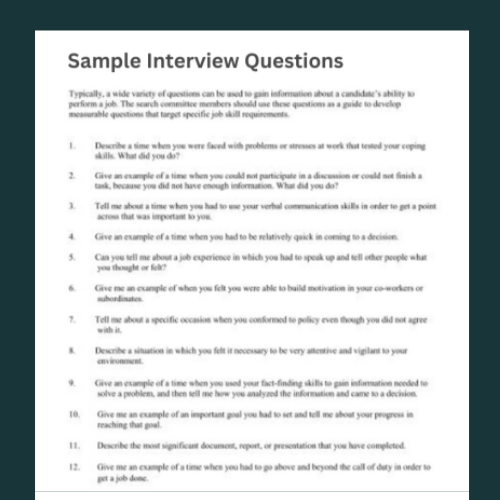
Search firms ask for evidence, not adjectives. The questions are built from the mandate and follow a deliberate arc: establish the referee’s vantage point, test specific claimed outcomes, probe behaviour under pressure and team impact, then close by inviting the referee to volunteer what has not been asked.
Whether the calls are led by the search consultant or by the Chair directly, the same mandate-led structure should hold, and the report should read the same either way. What that report separates matters as much as what it contains: verified fact, referee opinion, and the consultant’s interpretation of both. Blurred together, they leave a board with a view it can neither assess nor defend. A report of general impressions means the referencing was a formality, whatever the fee note says.
The arc matters more than any single question, but these do consistent work:
- Scope: ‘What was their remit when they joined, and how had it changed by the time they left?’
- Ownership: ‘Of the outcomes on their CV, which did they personally own rather than inherit?’
- Disagreement: ‘Describe a decision of theirs you disagreed with. How did they handle being challenged?’
- Team: ‘Who did they promote, and who left?’
- Calibration: ‘Would you hire them again, into what role, and what conditions would you attach?’
- Omission: ‘Is there anything I haven’t asked that I should have?’
That last question routinely produces the most valuable thirty seconds of the call, because the referee, rather than the consultant, decides what matters. It is also the question most often missing from a reference report, and its absence is worth asking about.
How Search Firms Verify an Executive’s Track Record
Executive candidate verification confirms facts rather than opinions, and runs independently of referees. But the value lies in interpretation, not retrieval: Companies House, the awarding bodies and the FCA register tell you what happened, while judgement establishes whether a resignation, a filing gap or an omitted directorship actually matters.
Retrieval is the straightforward part. Qualifications are confirmed directly with ICAEW, ACCA, CIPD or the awarding university, never from a copy supplied by the candidate. Appointments and disqualifications come from Companies House and the Insolvency Service. Since 18 November 2025, identity verification has become compulsory for new directors and is being phased in for existing directors and persons with significant control. A new director must provide their Companies House personal code as part of the appointment filing.
Interpretation is where search experience shows:
- A resignation dated shortly before administration or a CVA. Sometimes a director lost the argument about solvency; sometimes they saw what was coming and stepped away from the consequences. Compare the resignation date against the filing history, then ask.
- A directorship on the register that is missing from the CV. Omissions are more revealing than exaggerations, and there is usually a reason it was left off.
- A turnaround the candidate claims that began before they arrived. Filing history dates the recovery and the register dates the appointment. Where the two do not line up, ask what they actually changed.
A discrepancy is a question, not a verdict. Judge the quality of the explanation rather than the existence of the entry.
How Search Firms Handle Difficult References
Conflicting references are signal, not noise. Search firms establish whether the disagreement concerns capability or context, weight each account by proximity and recency, look for a pattern across several referees rather than a single outlier, and give the candidate a right of reply before drawing conclusions.
Most conflict resolves into one of three explanations:
- Context, not capability – A CFO who struggled under private equity ownership may be well suited to an owner-led business, and vice versa. The reference is accurate and still not predictive of your environment.
- Proximity – A referee two levels removed, or five years distant, describes reputation rather than performance. Weight someone who set the candidate’s objectives above someone who merely observed them.
- A genuine dispute – Occasionally a negative reference reflects a personal or political falling-out. One outlier against five consistent accounts is worth understanding, not necessarily acting on.
Then give the candidate the chance to respond. How they handle a difficult question about their own record is itself evidence, and it is the one point in referencing where you observe the candidate directly rather than through someone else’s account.
Legal and Data Protection Limits on Executive Vetting
UK vetting operates within clear limits. The ICO expects pre-employment checks to be justified by identified risk, proportionate to the role, disclosed to the candidate in advance, and held no longer than necessary. Employers giving references owe a duty of reasonable care and accuracy, which explains why many now restrict what they will say.
On the vetting side, ICO guidance is explicit that checks should not be routine: identify a specific risk, tell the candidate what you will check and why, and use the least intrusive method that answers it. Where social media is reviewed, the reviewer should not be the decision-maker. Reference notes are personal data, so hold them securely and retain them only under a defined, proportionate retention policy.
On the giving side, a former employer must take reasonable care that any reference is true, accurate and fair, and a negligently misleading one can expose them to a claim. There is no general UK duty to give one at all, which is precisely why factual-only policies spread, and why the telephone conversation now carries what the letter no longer does.
General guidance on UK practice, not legal advice. Take specialist employment law advice on any specific appointment or vetting programme.
What Executive Due Diligence Cannot Tell You
Executive due diligence establishes what someone has done, not what they will do. It cannot test performance in a context the candidate has never worked in, it cannot correct for referees with an interest in the outcome, and it cannot tell you how your existing leadership team will react to the person you appoint.
Three limits are worth naming before you rely on the output:
- It is backward-looking. A CEO who trebled revenue in a mature category has proved something about that category. Buy-and-build under an impatient investor is a different job, and no reference confirms they will do it.
- Referees have interests. Sincerity is not disinterest. The mitigation is a wider referee set, not a better judge of character.
- There is no counterfactual. You never discover how the candidate you rejected would have performed, so referencing cannot be validated by outcome. Boards routinely over-learn from a single good or bad hire.
The practical response is not more diligence. Use leadership candidate assessment for the forward-looking questions, then design around the risk that remains: a defined 90-day review, explicit first-year objectives, a reporting line that gives the board early sight of trouble. Residual uncertainty is a condition to manage, not a defect to eliminate.
Conclusion
The output of executive due diligence is not a verdict on a candidate but a decision your board can defend. Three outcomes are legitimate: appoint, appoint with conditions, or withdraw. Most boards recognise only the first and the last, and either lose good candidates or accept avoidable risk as a result.
The middle option is where most of the value sits: a documented concern paired with a designed mitigation, whether that is a revised reporting line, a first-100-days objective or a stronger deputy, beats both a nervous yes and a wasted no. It is also the option boards skip most often, and the reason is rarely analytical. Conditions have to be owned by someone, written down, and revisited in twelve months in front of the people who approved the appointment. Nobody volunteers for that at the end of a long search, so the finding gets absorbed into the enthusiasm instead.
That is a standard you can hold a search partner to. Before signing a mandate, ask:
- Who will conduct the references, and how senior are they?
- How many referees, and how many from outside the candidate’s own list?
- At what point will referencing happen, before or after offer?
- What will we receive in writing, and what will you not put in writing?
A firm that cannot answer those four crisply is planning to confirm your decision rather than test it.
On your next senior appointment, the question will not be whether references were taken. It will be whether anyone was still willing to act on them. For the wider process these checks sit within, see our guide to the executive search process for employers.
If you are scoping a board or C-Suite appointment and want to settle the due diligence standard before the search begins rather than after the shortlist, our consultants are happy to talk it through.
Frequently Asked Questions
Named referees with their relationship and vantage point stated, and the specific outcomes each was asked to verify. Expect disagreement between referees to be recorded rather than smoothed into a consensus view. Where a referee has asked for something to remain unattributed, that should be relayed verbally and recorded as such, not quietly omitted.
Declining to name a current employer before a conditional offer is normal and expected. Declining to provide anyone at all from a specific role or period is a different matter, and it warrants a direct conversation rather than an inference. Ask why, and whether someone else from the same period is available. A candidate who can offer nobody from a three-year tenure has told you something, though not necessarily what you first assume.
A conditional offer made subject to satisfactory references can normally be withdrawn if those conditions are not met, provided they were stated clearly in writing at the outset. An unconditional offer is far harder to unwind and may create contractual exposure, so the wording of the offer letter matters as much as the finding itself.
Allow two to three weeks for a full process. Structured references take five to ten working days to schedule and complete, as senior referees are hard to reach. Credential verification takes three to five working days. FCA regulatory references take longer, since the previous employer must compile six years of disciplinary and conduct information.
The layers are the same but the evidential standard is higher. Investors expect documented referencing against the value-creation plan, verified directorship and insolvency history, adverse media screening, and formal leadership assessment. Where an appointment sits on a transaction timetable, agree the scope at mandate stage so it does not become the critical path.






Related Posts

Executive Onboarding Support: What Happens After Placement?
The search concludes when the contract is signed. The appointment does not. Executive onboarding support covers everythi…

From Shortlist to Offer: The Executive Selection Process
Much of the groundwork, and with it much of the risk, in a senior appointment is settled well before the board sees a sh…

How Do Executive Search Firms Assess Candidates?
A confident interview and a strong CV tell you very little about how a leader will perform once the pressure o…

What Happens During the Executive Search Discovery Phase?
Most failed executive appointments can be traced to a decision made before a single candidate was approached. …

How Do Executive Recruiters Source and Attract Top Talent?
Every board knows the best executives are not on the market. The less comfortable point is that most hiring is still bui…

The 7 Stages of Executive Search Explained
Every executive search follows a similar architecture, yet the difference between a mandate that secures a transformatio…